Lab for Accelerated Computing in Engineering and Science
Empowering Innovation Through Multiscale Modeling and Advanced Simulation Technologies on Leadership-Class Supercomputers and Emerging Hardware
Projects
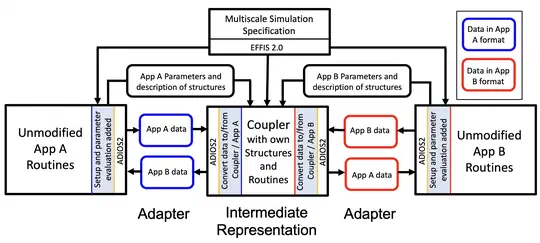
Fusion power promises to be one of the most transformative technologies of our time, however, many fundamental questions about plasma physics and reactor operation remain. Answering these questions requires exascale multiscale and multiphysics simulations and a broad range of domain and computational expertise. Over the past 50 years, large teams have invested thousands of person-hours into the development of software that can efficiently simulate the physics in specific portions of the reactor volume that use fundamentally different discretizations, time-stepping methods, mathematical models, and so forth. Given the need for specialized numerics in each part of the reactor volume, and the expertise required to do so, it is not feasible to develop a new multiphysics code that encompasses the entire reactor volume using a homogenized framework. Currently, coupling methods exist for specific applications (i.e., core-edge), but do not scale to the needs of full-device, or full-plant modeling. This Project develops a new framework for tight-coupling of distinct codes at-scale on exascale supercomputers. It will describe the approach for data-transfer, parallel control, and interrogation-based field transfer operations.
Fibrous materials are common in engineering and biology with applications ranging from geotextiles to the extracellular matrix, collagen and actin gels. Modeling these materials on the engineering or biological scale is difficult because they move nonaffinely, are nonlocal, and heterogeneous. On one end of the spectrum, discrete network models can capture these micromechanics, but due to computational cost are precluded from modeling structures at the scales of interest. On the other end, continuum models can rapidly simulate biological or engineering scale behavior, but cannot capture the micromechanical complexity which is important for understanding disease progression.
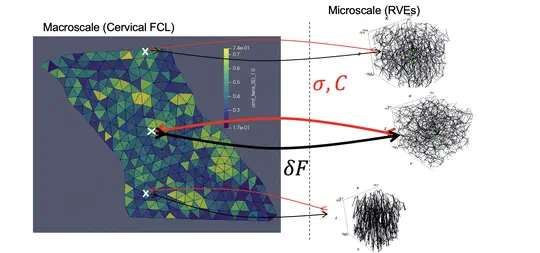
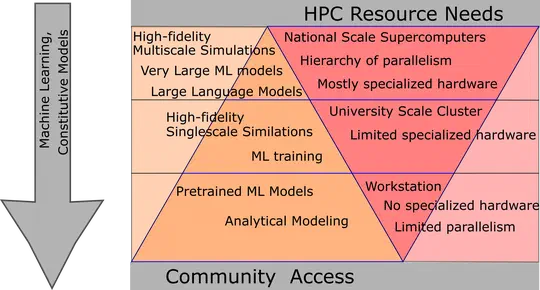
Hi-fidelity multiscale simulations using frameworks such as MuMFiM are necessary to develop an understanding of fibrous materials on an engineering or biological scale. However, they require significant computational resources and HPC expertise that are out of reach for most biomechanicians. This project seeks to develop constitutive models for fibrous materials making use of machine learning methodologies.
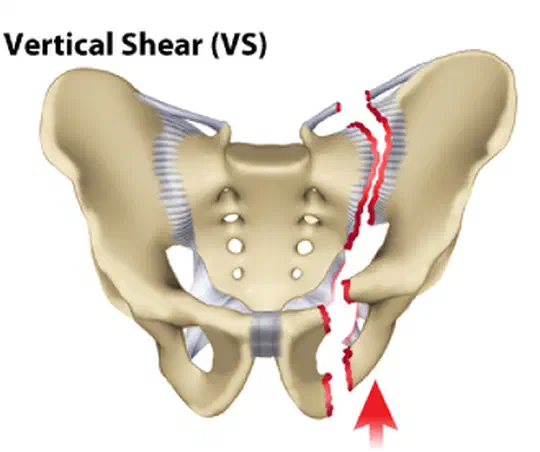
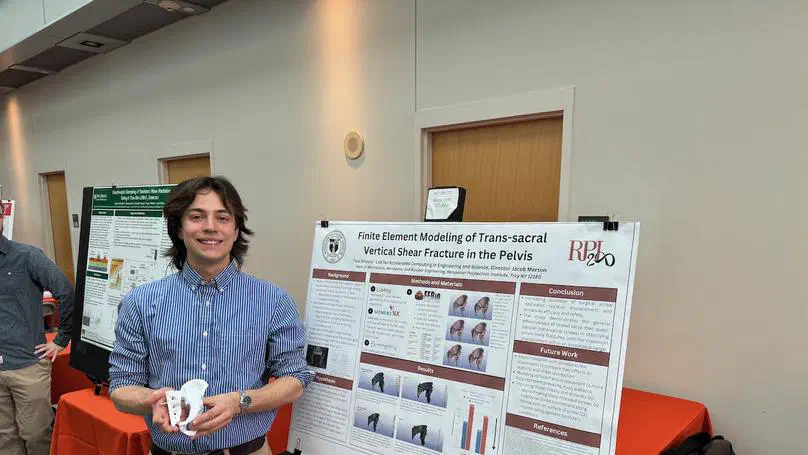
This project is developing models of Vertical Shear Fracture in the Pelvis on patient specific geometry. It is a collaborative effort with Dr. Regis Renard (UAMS), and Dr. Brian Salazar (U.C. Berkeley).