Abstract
Thermally aware design of 2.5 D and 3 D advanced packaging systems will require fast, accurate, and powerful thermal analysis of chiplets, stacks, and packages. These systems contain multiple materials with non-linear heat transfer properties and geometric feature sizes that span many orders of magnitude. The smallest heterostructures in the front and back ends of the line present significant thermal modeling and analysis challenges in isolation. Replicated millions or billions of times in a chiplet stack, these structures present a near insurmountable hurdle to meeting the speed and accuracy needed of analysis in the design process. Additionally, establishing precise parameter values for the materials in these systems, when size and temperature dependencies create significant deviations from bulk properties, further complicates the problem. To address these issues, we have developed a multiscale methodology that advances the current state of the field by enabling die-scale simulations that capture phenomena arising from the structural details of the BEOL metallization stack. Taking advantage of the large length-scale separation between the BEOL features and the die-level structures, we employ a hierarchical, multiscale, finite-element approach. This hierarchical method uses a standard finite element method (FEM) formulation on a die or package scale, using computational homogenization to obtain effective thermal conductivities in the BEOL. Referring to industry-standard layout and design files, we construct and solve a locally appropriate subscale FEM problem in a representative volume element (RVE) at every quadrature point in the macroscale FEM problem. To accomplish this calculation, in our multiscale workflow, all geometric models of these RVEs are automatically constructed, meshed, and used to compute homogenized, anisotropic, thermal conductivities from the relevant GDSII or OASIS files based on the FEM integration point locations. Here, we make use of a direct, static- condensation based method to extract the full thermal conductivity tensor.
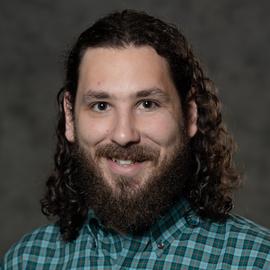
Jacob Merson
Assistant Professor of Mechanical Engineering
loves to scale multiphysics simulations onto leadership class supercomputers